



Doubly Ventilated Sulfur: The Role of This Input in Rubber Vulcanization and Compound Quality
Rubber vulcanization is one of the most decisive processes for transforming an originally unstable material into a high-performance elastomer.
In its initial natural or synthetic state, rubber presents plastic and viscoelastic behavior that depends on temperature, with a tendency toward permanent deformation under mechanical stress and instability under extreme thermal conditions.
This scenario changes completely with vulcanization, which promotes the formation of a three-dimensional network of chemical bonds between polymer chains. This crosslinked structure limits molecular displacement and allows the material to withstand severe deformations, returning to its original shape with high elastic efficiency.
The quality of this network of crosslinks directly defines properties such as tensile strength, abrasion resistance, tear resistance, and dimensional stability. For this reason, the choice of industrial inputs for rubber used in the formulation is not only relevant, but decisive for the final performance of the elastomeric compound.
Within this context, sulfur stands out as the main vulcanizing agent, responsible for enabling this structural transformation with chemical precision and rheological control.
What Sulfur Is and Its Function in Vulcanization
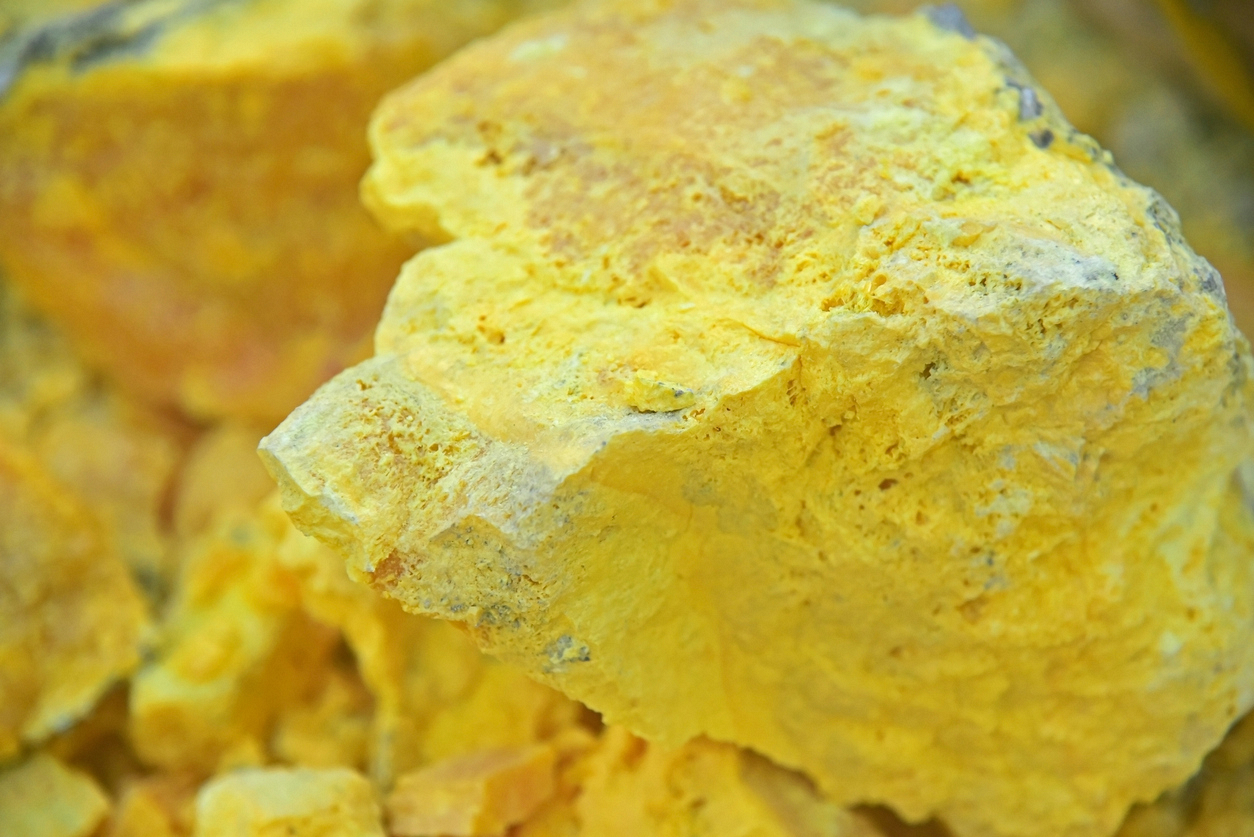
Sulfur for vulcanization is a chemical element widely used as a crosslinking agent in unsaturated elastomeric polymers. It acts directly in the creation of chemical bridges that connect polymer chains, enabling the formation of the three-dimensional network that characterizes vulcanized rubber.
During the controlled heating process, sulfur molecules undergo transformations that generate reactive species capable of interacting with the unsaturation sites of the polymers. This reaction results in the formation of different types of sulfidic bonds, whose proportion directly influences the performance of the final material.
Monosulfidic bonds, for example, provide greater thermal resistance and stability, while polysulfidic bonds favor flexibility and fatigue resistance. Disulfidic bonds, in turn, balance these properties, offering intermediate performance.
However, the success of this process depends on a critical factor: the dispersion of sulfur in the polymer matrix. Due to its low solubility at lower temperatures, much of the sulfur remains in solid form during mixing, requiring high efficiency in its distribution to avoid structural failures.
This technical limitation has driven the development of more advanced solutions, such as doubly ventilated sulfur, which emerges as a response to the precision requirements of modern industry.
What Doubly Ventilated Sulfur Is
Doubly ventilated sulfur represents a technological evolution in the processing of this input, developed to overcome the limitations of conventional sulfur in critical industrial applications.
It is characterized by a high degree of purity and extremely controlled particle size distribution, resulting from advanced air classification processes. This refinement enables greater dispersion efficiency and greater predictability in behavior during vulcanization.
Ventilation Process
The ventilation process consists of a pneumatic classification operation, in which particles are separated based on size, mass, and aerodynamic behavior.
During this stage, larger particles are continuously recirculated until they reach the desired standard, while fine particles move on to the final product.
In the case of doubly ventilated sulfur, this process occurs in multiple stages, resulting in an extremely narrow particle size distribution. This control virtually eliminates the presence of coarse particles, which are responsible for failures in elastomeric compounds.
Another critical point is process safety. Production takes place in an inert nitrogen atmosphere, reducing the risk of dust explosion. At the same time, ammonia injection neutralizes possible traces of acidity on the particle surface, ensuring chemical stability and avoiding interference with vulcanization kinetics.
Technical Characteristics
The result of this process is a material with highly uniform micrometric particles, a large surface area, and excellent dispersion capacity.
This characteristic allows sulfur to react more efficiently during the thermal cycle, reducing the presence of unreacted material and increasing the homogeneity of the crosslink network.
The combination of controlled particle size, chemical passivation, and a safe production environment positions doubly ventilated sulfur as a high-performance input for demanding industrial applications.
Differences Between Common Sulfur and Doubly Ventilated Sulfur
The differences between common sulfur and doubly ventilated sulfur are significant and directly impact the performance of the rubber compound.
Conventional sulfur has an irregular particle size distribution, with fine particles mixed with larger agglomerates. This heterogeneity makes dispersion more difficult and requires greater mechanical effort during mixing, increasing process temperature and raising the risk of premature vulcanization.
Doubly ventilated sulfur, on the other hand, has uniform and extremely fine particles, which facilitates its incorporation into the polymer matrix. This characteristic reduces mixing time, lowers shear effort, and improves thermal control of the process.
Another relevant point is the formation of hotspots. In common sulfur, coarse particles can generate regions with excessive curing, creating weak points in the material. In doubly ventilated sulfur, the homogeneous distribution eliminates these variations, resulting in consistent mechanical properties throughout the part.
This difference in behavior directly impacts the reliability of the final product, especially in critical applications.
Operational and Industrial Benefits
The adoption of doubly ventilated sulfur brings significant gains to industrial operations, impacting productivity, quality, and safety.
Better Dispersion
Fine particle size allows sulfur to be uniformly distributed in the elastomeric matrix, ensuring homogeneous vulcanization throughout the part.
This uniformity results in more stable and predictable rheometric curves, allowing more precise adjustments to process parameters and reducing variations between batches.
Dust Reduction
The control of ultrafine particles and the development of pre-dispersed versions contribute to a significant reduction in dust generation in the industrial environment.
This improves working conditions, reduces occupational risks, and minimizes the need for complex exhaust systems.
Greater Operational Safety
Production in an inert atmosphere and particle size control reduce the risks of explosion and fire, which are common when handling combustible dusts.
The chemical neutralization of sulfur prevents interference with the curing process, ensuring greater operational stability and predictability.
Another relevant benefit is the mitigation of the blooming phenomenon, preventing sulfur from migrating to the surface of the final product and preserving its aesthetic and functional properties.
Industrial Applications of Sulfur in Rubber Compounds
The use of sulfur in the rubber industry covers several strategic markets, each with specific technical requirements.
In the tire industry, vulcanization uniformity is essential to ensure fatigue resistance, durability, and operational safety. The use of doubly ventilated sulfur helps prevent structural failures and increase product service life.
In the automotive segment, the material is applied in components such as seals, bushings, and retainers, where properties such as mechanical strength and dimensional stability are essential.
The footwear industry also benefits directly, especially in the production of soles, where blooming control is decisive for maintaining the product’s aesthetic and functional quality.
Other markets include marine systems, offshore components, conveyor belts, industrial hoses, and technical rubber goods.
These sectors require high mechanical performance and reliability, reinforcing the importance of inputs with a high level of technical control.
Intercuf Doubly Ventilated Sulfur and Distribution by Fragon
The quality of doubly ventilated sulfur is directly linked to the manufacturer’s technical capability and the reliability of the distribution chain.
Intercuf stands out for applying advanced double ventilation processes, control in an inert atmosphere, and chemical passivation, ensuring a product with a high level of consistency and performance.
This quality standard is essential to meet the requirements of the elastomer industry, where small variations can compromise the entire production process.
In Brazil, this input is distributed by Fragon, which acts as a strategic partner for the industry. With a strong presence in the sector and a robust logistics structure, the company ensures continuous supply, proper storage, and specialized technical support.
This operating model directly meets the needs of industrial companies seeking reliability, predictability, and consultative support in the selection of raw materials.
The combination of production technology and excellence in distribution allows customers to operate with greater safety and efficiency, reducing risks of downtime and rework.
Conclusion
The evolution of raw materials for rubber shows that control over sulfur particle size and purity is a decisive factor for the performance of elastomeric compounds. Doubly ventilated sulfur has established itself as a technical solution capable of raising the standard of quality, safety, and productivity in the industry.
Its ability to promote uniform dispersion, reduce operational risks, and ensure stability in the vulcanization process makes this input indispensable for applications that require high performance and reliability.
If your company seeks to optimize formulations, reduce losses, and increase production predictability, having a technical partner makes all the difference. Fragon offers specialized support and access to Intercuf doubly ventilated sulfur, connecting your operation to the best solutions on the market.
Contact a specialist and evaluate how this technology can enhance the performance of your rubber compounds with safety and consistency.